
Research
Papers, patents and graft retention data. Every figure quoted on this site is sourced from this page. Based on about 9,000 research records, the center has published four papers; the two with confirmed bibliographic details are listed first below.
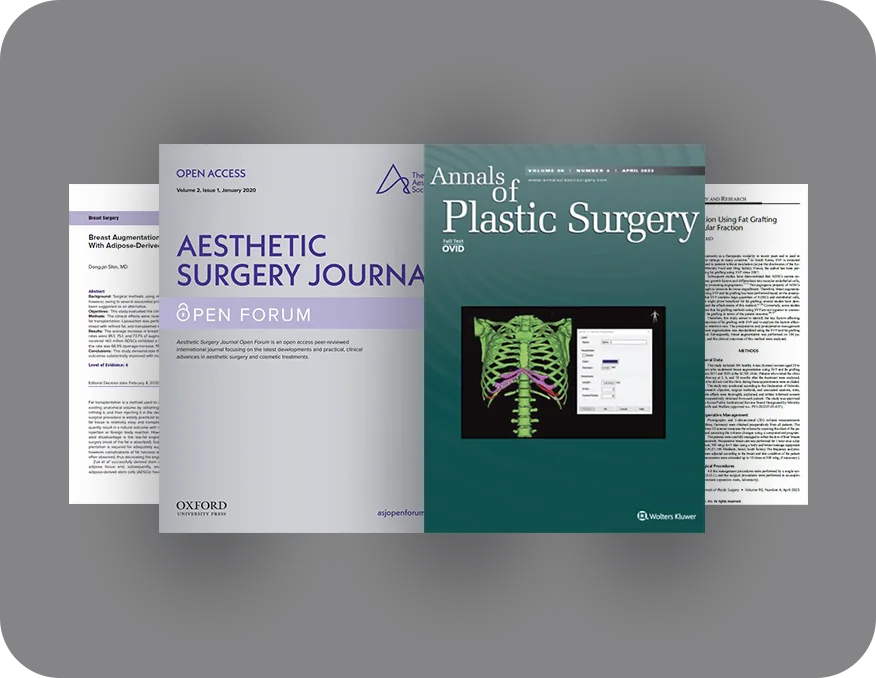
Annals of Plastic Surgery, 2023 (SCI-indexed)
A Study on Breast Augmentation Using Fat Grafting With Stromal Vascular Fraction
- Research question
- What is the graft retention rate of SVF-assisted fat grafting for breast augmentation, and which factors affect it?
- Design
- Single-center cohort. Women aged 20–59 who had surgery at SC301 Clinic between 2017 and 2019. Approved by the public institutional review board (IRB) designated by the Ministry of Health and Welfare; written informed consent obtained in advance
- Patients
- 384 patients. Mean preoperative breast volume 212.54 mL; mean injected volume in the left breast 162.35 mL (range 50–260 mL). Number of SVF cells isolated: 14.9 million to 262.5 million
- Measurement
- Pre- and postoperative volumes measured with an Axisthree 3D scanner; ratio of retained volume to injected volume. Follow-up at 3 months (384 patients), 6 months (273) and 18 months (102)
- Main results
- Graft retention rate: 78.65% at 3 months · 77.17% at 6 months · 77.48% at 18 months
- Cell count
- 18-month retention rates of 85.60% and 70.77% in two groups divided at 60 million cells. The paper concludes that a higher cell count was associated with greater retained volume (the PubMed abstract lists the group labels for the two figures the other way round, so check against the full text)
- Tissue softness
- Classified by a preoperative pinch test. 18-month retention rate: 85.09% in soft breasts, 65.62% in firm breasts
- Left–right difference
- At 18 months, 77.48% on the left and 60.35% on the right (P<0.05). Interpreted in relation to habitual heavier use of the right arm
- Complications
- Cystic nodules found in 5 patients at 6 months; they resolved spontaneously without treatment after about 2 years
- Conclusion
- Limiting arm movement, increasing the number of SVF cells and improving skin tension may raise the graft retention rate
- Limitations
- The number of patients measured falls at later follow-up points (384 → 102). The data come from a single center without a control group.
How to read this number
The graft retention rate is the proportion of grafted fat volume that remains after a given period. Because the figure changes with the measurement method and time point, first check whether another study used the same method before comparing.
77.48% is the mean value obtained for the patients and measurement conditions of this paper. Individual retention rates vary with constitution and fat condition. Whenever the center quotes this figure, it always states the paper and the conditions alongside it.
Postoperative care principles stated in the paper
- Oral antibiotics for 5 days after surgery
- Dressing change the day after surgery; stitches removed after 1 week
- Avoid excessive arm use and exercise (swimming, golf, yoga, etc.) for about 6 months after surgery
- No pressure or massage on the breasts
- Regular meals so that body weight does not fall below the weight on the day of surgery
Read the plain-language explainer · Research note commentary (Korean)
Oxford journal, 2020
A study based on the center's experience with SVF procedures was published in an Oxford journal in 2020.
Breast Augmentation by Fat Transplantation With Adipose-Derived Stem/Stromal Cells
- Patients
- 105 patients. Patients seen at each time point: 86 at 1 month, 70 at 3 months, 32 at 6 months
- Method
- Fat harvested from the abdomen and thighs; adipose-derived stem/stromal cells isolated, mixed with purified fat and grafted into the breasts. Retention calculated against the volume at 1–2 weeks, once swelling had subsided
- Main results
- Retention: 85.07% at 1 month · 75.06% at 3 months · 73.65% at 6 months. About 3 months after surgery is regarded as the point at which graft take is largely complete
- Observations
- Thick, low-elasticity tissue offers too little space for the graft, so retention is lower. Survival fell in patients who did exercise involving strong pectoral muscle movement. Over-injection raises the risk of fat necrosis and calcification
- Mechanisms
- Four points: ADSCs differentiate into fat cells and vascular cells, secrete growth factors such as VEGF, HGF and IGF-1, and divide to maintain cell numbers
- Caution
- The 2020 paper uses the volume at 1–2 weeks as its baseline and the 2023 paper uses the injected volume, so the two figures cannot be compared directly
Three fat-grafting patents
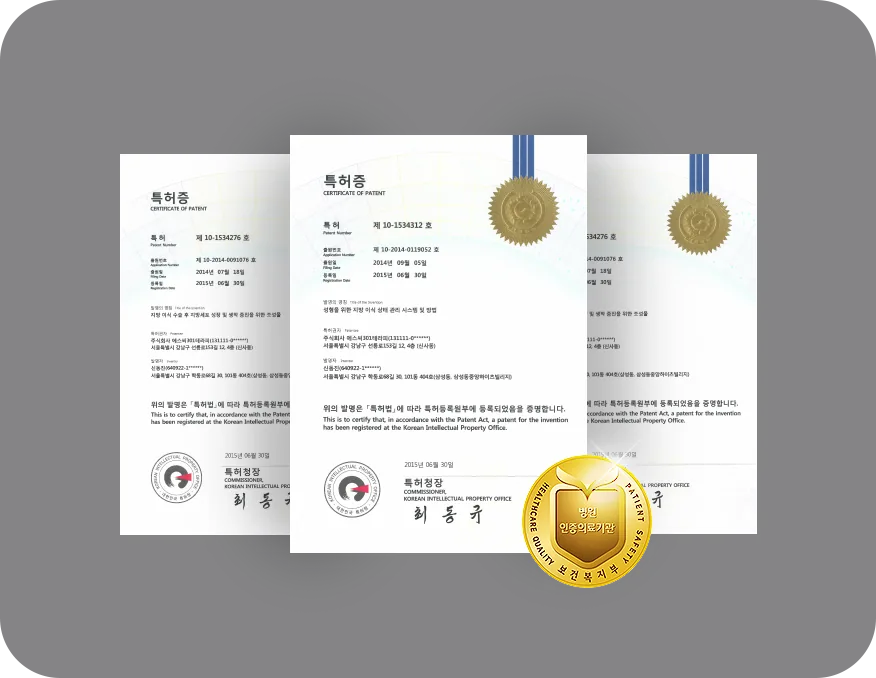
The center holds three patent certificates. The numbers below are read from the certificate images posted on the clinic's main website.
| Patent title | Registration no. | Registered | Description |
|---|---|---|---|
| Composition for promoting fat cell growth and graft retention after fat grafting surgery | No. 10-1534276 | 2015-06-30 | Filed 2014-07-18 (10-2014-0091076). Relates to how long results last |
| System and method for managing the condition of fat grafts for cosmetic surgery | No. 10-1534312 | 2015-06-30 | Filed 2014-09-05 (10-2014-0119052). Aftercare during the graft stabilization period |
| Body-customized breast augmentation assist device | No. 10-2038995 | 2019-10-25 | Filed 2019-03-21 (10-2019-0032358). Reflects each person's anatomical conditions from the design stage |
Patent holder: SC301 Co., Ltd. · Inventor: Shin Dong-jin. Patent titles follow the SC301 Stem Cell White Paper and can be looked up by number on the Korean Intellectual Property Office's patent search service (KIPRIS).
What external research says
Key 2024–2026 literature for reading the center's results alongside other studies. Commentary reviewed by Dr. Shin Dong-jin, Chief Director, is available in the research notes (Korean).
| Study | Design | Main findings | Limitations stated by the authors |
|---|---|---|---|
| Jefri et al., Aesthet Plast Surg 2026 | Meta-analysis, 18 studies, 893 patients | Graft retention with SVF-enriched fat grafting was on average 17.20 percentage points higher than with conventional fat grafting. No difference in rates of cysts or fat necrosis | Very high heterogeneity between studies (I²=98%). Standardization and long-term follow-up needed |
| Shimizu et al., Plast Reconstr Surg 2026 | Meta-analysis, 31 studies, 1,426 patients | Retention 26.8 percentage points higher with ADSC enrichment; 17.0 points for SVF methods alone | Breast reconstruction patients, so the population differs from cosmetic cases |
| Wufuer et al., Plast Reconstr Surg 2024 | Multicenter randomized controlled trial of facial fat grafting, 23 patients | 24-week retention: 71.27% in the SVF group vs 61.98% in the control group | Small sample |
| Sforza et al., Stem Cell Res Ther 2025 | Meta-analysis of mechanical isolation, 22 studies | Mechanical isolation also preserves cell viability (up to 98%) and differentiation capacity | Fewer cells recovered than with enzymatic methods |
| Wang et al., Chin Med J 2019 | Systematic review of graft retention measurement methods | Reported retention rates ranged from about 36% to 82% depending on the measuring tool and time point | Check baseline and tools when comparing studies |
Latest trends in SVF research (Korean)
The direction of regenerative medicine through 2025–2026 papers: meta-analyses, isolation methods, regulatory changes.
Research review · 2026-09Why add stem cells to fat grafting (Korean)
Angiogenesis through VEGF, and three levels of evidence.
Research review · 2026-09The baseline for comparison (Korean)
Where conventional fat grafting without added SVF stands today.
Source DOIs: 10.1007/s00266-025-05511-6 · 10.1097/PRS.0000000000012421 · 10.1097/PRS.0000000000010625 · 10.1186/s13287-025-04641-7 · 10.1097/CM9.0000000000000415
Academic activities and awards
As listed in the SC301 Stem Cell White Paper (2026).
- Founded the Korean Society of Stem Cell Plastic Surgery in 2009 · served as president for 10 years
- APACS (international aesthetic plastic surgery congress) — presentation on stem cell breast augmentation
- Presentations at the 53rd Seoul International Aesthetic Plastic Surgery Congress, Korean international aesthetic plastic surgery society seminars and others
- Proud Korean Award — medical advancement category
- ASIA LOHAS Food & Environment Invention Award — Minister of Health and Welfare Award
- Medical Asia Award — stem cell category
- MOU on SVF treatment with Yonsei University Gangnam Severance Hospital
- Selected as a Gangnam-gu medical tourism partner institution
- Ministry of Health and Welfare accredited healthcare institution
How is graft retention data studied?
The center's work does not end on the day of surgery. It has followed the process below since 2007.
Cell counts and viability measured with the cell counter for every surgery are gathered together with postoperative follow-up results.
Volume changes before and after surgery are measured and quantified with the 3D precision check, and the Big Data Lab analyzes them.
Results are written up with the study design, patients and measurement methods, reviewed by university hospitals and research institutions, and submitted to journals.
Papers are published after peer review by international journals. Four have been published so far.
About 9,000 graft retention records
Only aggregate figures that can be made public are posted; no personally identifiable information is included.
About 68 million to 99 million
Based on published cases of SVF-assisted breast fat grafting. Varies with the amount and condition of the harvested fat.
Cell counter (NanoEnTek)
Measures the number and viability of the SVF cells actually injected in every surgery.
Pre- and postoperative 3D precision check
Graft retention is assessed separately, from the change in volume before and after surgery.